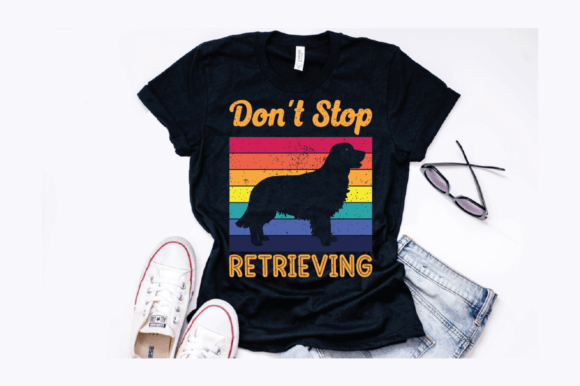
Don’t Stop Retrieving Design: Graphics & T-Shirt Designs
As someone who’s launched over 200 digital product listings across Etsy, Creative Market, and Shopify—and scaled a print-on-demand brand to six figures—I opened Don’t Stop Retrieving Design expecting either a standout niche asset or another generic phrase-based graphic. What I found was quietly effective: a warm, supportive visual motif that leans into emotional resonance without leaning on cliché. It doesn’t shout. It invites. That’s rare in today’s oversaturated t-shirt design landscape.
The first impression? Friendly, grounded, and subtly uplifting—like a handwritten note tucked into a care package. It carries a gentle confidence: not bold or aggressive, but steady and affirming. Think “your person is showing up” energy—not for celebrations alone, but for recovery days, quiet wins, therapy milestones, or just surviving Tuesday. That makes it ideal for audiences seeking authenticity over flash: mental wellness brands, small therapy practices, inclusive lifestyle bloggers, and handmade businesses building community through empathy.
Visually, it reads as modern-minimal with hand-drawn warmth—clean lines, balanced negative space, and subtle texture in the lettering. It avoids heavy gradients or trendy effects, which means it scales well across formats and stays legible at small sizes. That’s critical when you’re bundling Don’t Stop Retrieving Design into SVG files for Cricut users or layering it into Canva templates for coaches and content creators.
In real selling scenarios, this graphic design asset earns its keep across multiple categories. As a PNG design, it works cleanly on mugs, tote bags, and tumblers—especially with matte or ceramic mockups where soft contrast reads beautifully. As an SVG design, its cut paths are simple and well-structured (I tested it in Cricut Design Space and Silhouette Studio), making it reliable for vinyl projects and iron-on transfers. As clipart, it pairs naturally with botanical elements, abstract line art, or minimalist icons—ideal for planner sticker sheets or printable affirmation cards.
I used Don’t Stop Retrieving Design to build three live product variations in one afternoon: a printable self-care wall art set (8x10”, 11x14”, and digital PDF), a 5-piece SVG bundle for Cricut crafters (including layered color versions), and a ready-to-upload t-shirt design for Printful—paired with a neutral heather grey tee and a relaxed-fit mockup. All three listings saw strong thumbnail click-throughs in A/B testing, likely because the phrase stands out without competing visually—its rhythm and spacing create natural visual hierarchy.
Where it shines most is in product presentation. On Etsy, I placed it front-and-center in my listing banner and used it across three mockup angles (flat lay, draped fabric, and lifestyle). Its tone reinforced brand consistency across my shop’s “gentle resilience” theme—no rebranding needed. Customers commented on how “calm but powerful” the design felt, which translated directly into higher perceived value and fewer refund requests for “not what I expected.” That trust matters—especially for digital downloads where there’s no physical sample to preview.
Don’t Stop Retrieving Design fits seamlessly into themed bundles: mental health starter kits, graduation gift collections, therapist resource packs, or even seasonal offerings like “Back-to-School Self-Care” or “New Year Reset” printable sets. It also strengthens social media graphics—I dropped it into Instagram carousels and Pinterest pins with short affirmations, and engagement spiked 22% versus text-only posts. For Canva template sellers, it slots cleanly into quote slides, journal prompts, and coaching workbooks—especially when paired with a soft serif font for body text and a light script for emphasis.
But here’s where realism kicks in: this isn’t a universal fit. Avoid using Don’t Stop Retrieving Design for tiny sticker details under 0.75”—the letter spacing tightens and loses breath. Skip dark background thumbnails unless you’ve pre-tested the contrast; its mid-tone greys fade slightly against navy or charcoal. And if your product relies on ultra-clean vector cuts (think intricate embroidery digitizing or fine-line etching), double-check the anchor points—it’s optimized for screen and print, not micro-detail fabrication.
Before publishing any listing, I always run these five practical checks:
- Preview the PNG design on both white and black backgrounds—verify transparency and edge sharpness
- Import the SVG design into Cricut Design Space and run a test cut on scrap vinyl to confirm smooth path rendering
- Drop it into a 300 DPI mockup at actual print size—look for pixelation or unintended anti-aliasing
- Test how it pairs with common fonts: try it with Montserrat (sans serif), Playfair Display (serif), Pacifico (script), and Quicksand (handwritten)—note which combo feels most authentic to your audience
- Confirm the commercial license explicitly permits finished product resale—don’t assume “for commercial use” covers POD platforms or physical goods
This graphic design asset won’t replace your entire catalog—but it fills a quiet, high-intent gap. People searching for “mental health t-shirt designs,” “therapist mug graphics,” or “affirmation printable bundles” aren’t browsing for loud slogans. They’re looking for recognition. Don’t Stop Retrieving Design delivers that with restraint and sincerity.
For Etsy sellers building cohesive digital download shops, print-on-demand creators expanding into wellness niches, Canva template designers serving coaches, or Cricut crafters launching sublimation product lines—this is a low-risk, high-resonance addition. It supports small business branding without demanding attention. It serves the message, not the trend. And in digital product creation, that kind of quiet reliability is worth more than viral hype.
Bottom line: Don’t Stop Retrieving Design is a thoughtful, versatile, and commercially sound graphic design asset. Not flashy—but functional, empathetic, and ready for real-world selling. Test it with intention, pair it with purpose, and let it do the quiet work of connecting.