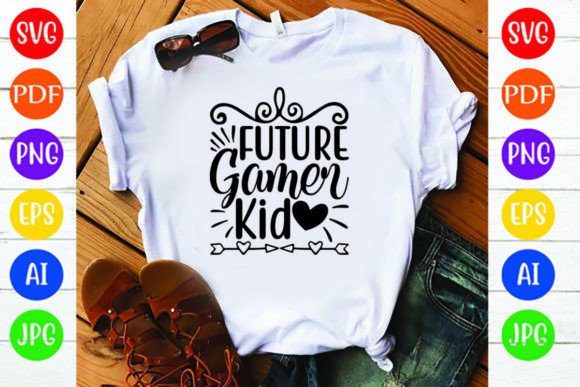
Future Gamer Kid Graphics for T-Shirt Designs
First Impression: Playful, Confident, and Instantly Recognizable
When I opened Future Gamer Kid for the first time in my design review workflow, what struck me wasn’t just its crisp vector precision—but its emotional resonance. This isn’t generic clipart. It’s a creative design with expressive posture, dynamic line work, and subtle tech-infused details (glowing headset, stylized controller, futuristic sneakers) that signal both youthfulness and aspiration. For brands targeting Gen Alpha, teen gamers, or parents of digital-native kids, it lands with warmth and energy—never childish, never sterile. It reads as modern design with commercial appeal: bold enough for merch, refined enough for editorial use.
A Real Campaign Fit: Launching a Summer “Game On” Content Bundle
I recently helped a small business launch a digital product—a Game On content bundle for educators and after-school program coordinators. They needed cohesive marketing visuals across email banners, Canva templates, Pinterest pins, and printable classroom posters. Future Gamer Kid became the anchor illustration. Its SVG and PNG transparent background formats made it effortless to layer over gradients, textures, and typography without clipping issues. We used the AI and EPS files to adapt proportions for Instagram carousels and Facebook ads—scaling cleanly from 1080×1350 down to 400×400 without pixelation. That versatility is rare in a single graphic design asset.
Where It Strengthens Brand Identity—and Where It Needs Context
Future Gamer Kid excels where visual hierarchy and emotional tone matter most: hero graphics for landing pages, campaign headers on blogs, branded templates for lead magnets, and packaging accents for limited-edition merchandise. As a social media graphic, it draws attention without overwhelming text. As a digital product visual, it signals fun, interactivity, and relevance. It supports stronger audience trust—not because it’s “professional” in a corporate sense, but because it feels intentional, well-crafted, and audience-aware.
That said, it’s not universal. Avoid using it in formal corporate branding, dense infographics, or text-heavy ads where clarity trumps personality. It can compete with the main message if placed over low-contrast backgrounds or alongside overly decorative script fonts. And while it scales beautifully, test readability at under 60px height—its fine details (like controller buttons) soften on tiny mobile thumbnails.
Practical Brand Designer Notes You’ll Want to Run Before Launch
- Test it with your brand color palette: The design allows full color customization—swap the neon blue hoodie for your signature coral or charcoal gray to align with existing visual hierarchy.
- Check black-and-white usage: Print it in grayscale for packaging inserts or school handouts—it retains strong silhouette definition, making it effective even without color.
- Place it inside real campaign mockups: Drop it into a t-shirt mockup, a Canva newsletter template, and a Pinterest pin layout to assess balance, breathing room, and focal weight.
- Preview on mobile screens: Use browser dev tools to simulate iOS and Android viewports—confirm legibility and spacing hold up.
- Pair it intentionally: It harmonizes beautifully with clean sans serifs (like Inter or Poppins), adds contrast against serif body copy (e.g., Merriweather), and grounds playful handwritten fonts when used as a supporting element—not the star.
- Verify commercial license: Since you’ll receive this design in AI, EPS, PNG, SVG, and PDF formats—all high-quality graphics—you’re covered for client work, paid ads, and small business branding, provided the source grants a commercial license (always confirm before use).
How It Fits Across Your Marketing Ecosystem
In packaging design, Future Gamer Kid works as a playful accent on sticker sheets or QR code labels—adding personality without cluttering product labels. In editorial design, it elevates blog headers about gamified learning or digital wellness. As a web design element, it anchors hero sections on landing pages for online coaching programs targeting young creatives. For content marketing teams, it speeds up production: swap colors, resize for Instagram Stories or email banners, drop into pre-built Canva templates, and ship consistent visuals in minutes—not days.
It also performs strongly as a printable design for event flyers (think library summer reading campaigns), as a digital ad asset for targeted Facebook promotions, and as a decorative brand element across media kits and pitch decks—where visual cohesion builds credibility faster than words alone.
Why Creative Entrepreneurs and Small Business Owners Should Pay Attention
This isn’t just another T-Shirt Designs download. Future Gamer Kid is a flexible, audience-aligned graphic design asset that reduces visual fragmentation across touchpoints. When your Instagram post, email header, and product label all share the same expressive tone—and the same scalable, editable foundation—you build recognition faster. That consistency directly supports better engagement, stronger first impressions, and more memorable campaign visuals.
For bloggers, publishers, and digital sellers, it’s a time-saving multiplier: one SVG design adapts seamlessly to blog graphics, Pinterest pins, and digital product covers. For online coaches launching themed cohorts (“Level Up Your Skills”), it becomes an instant visual shorthand—no custom illustration budget required. And for creative marketplace sellers, bundling it with complementary assets (like gamer-themed quote overlays or UI icons) creates a high-value design bundle with built-in thematic cohesion.
The Bottom Line: A Strategic Asset, Not Just a Decoration
Future Gamer Kid earns its place in your toolkit because it balances personality with professionalism. It’s not background noise—it’s a strategic visual cue that tells your audience, “This is for *you*.” Whether you’re refreshing seasonal offers, building a content kit, or designing merch for a community event, it delivers clarity, consistency, and creative confidence—without sacrificing quality or commercial flexibility. Just remember: great design assets don’t work in isolation. Test, adapt, and integrate. Then let Future Gamer Kid do what it does best—connect, energize, and elevate.